
Washoe County School District faces allegations of systemic failures in disability accommodations
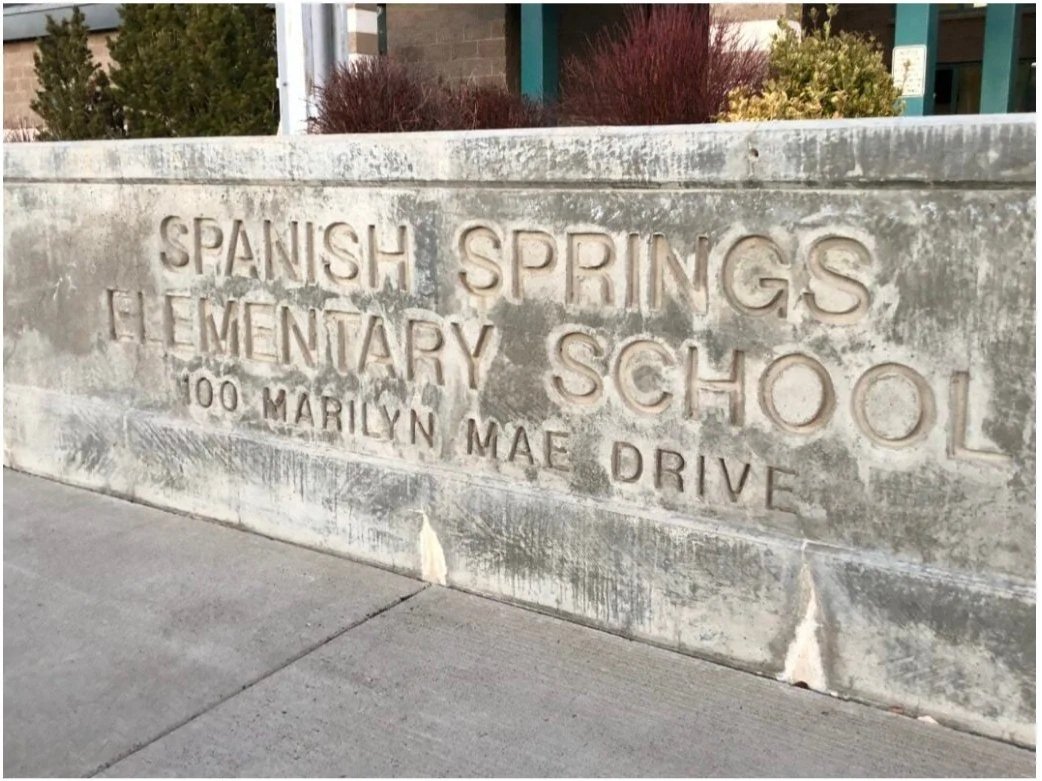
Spanish Springs Elementary School. Photo: Carla O’Day.
Parents allege school nurse forged medical records
By Nicole Fernandez - Published with This is Reno
The Washoe County School District is facing complaints after a school nurse allegedly denied a child federally regulated disability accommodations, forged medical documents to access private records and administered medication to a student without proper documentation. A school police report and complaints to other agencies have been filed in the case that occurred at Spanish Springs Elementary School.
Parents and advocates argue these issues extend beyond one school, and they are accusing the Washoe County School District of routinely delaying evaluations, downplaying requests for legally binding individualized education programs (IEPs)—which require specialized instruction and carry stronger enforcement—and pushing families into weaker 504 disability plans that only provide accommodations and are often left unenforced.
An IEP provides specialized instruction and legally enforceable services under the IDEA law, while a 504 plan only provides classroom accommodations under civil rights law and lacks the same level of enforcement.
“The most frequent 504 plan violations I see are inconsistent implementation of accommodations and lack of teacher awareness,” said Charitie Carpenter, a Family Life Educator with My Family Connection, and member of the Council of Parent Attorneys and Advocates (COPAA). “These issues aren’t isolated to one site — they’re systemic.”
A fragile start to the school year
In late July, the family of “Ava,” a 7-year-old student with a serious medical condition, learned she would be rezoned from her previous elementary school to Spanish Springs. At her prior school, Ava received consistent support under a Section 504 plan: rest breaks, access to snacks and water, and authorization for medications.
But within days of starting the new school year in August, those accommodations reportedly vanished. According to documentation and witness accounts, Ava was denied rest, snacks and water, which would violate her 504 accommodations. On Aug. 18, she suffered a severe fever of 108 degrees. Her family members said the lack of care put her at immediate medical risk.
When students don’t receive their accommodations, the impact can be significant. Carpenter said she has seen the toll firsthand.
“I’ve seen students fall behind academically, struggle with anxiety and self-esteem, and even disengage from school altogether,” she said. “When a student isn’t provided extended time or access to notes, they may be unfairly penalized for something tied directly to their disability.”
When the nursing staff at Spanish Springs Elementary reached out to Ava’s mother, the nursing assistant stated that she was unaware of a 504 plan in place for the student, according to the mom.
According to the nurse’s notations in the student’s official health file, discovered by Ava’s parents after receiving records from WCSD, the nurse questioned the accommodations in place. The mother also said she received multiple phone calls from the nurse questioning the 504 accommodations.
Forgery allegation
On Aug. 15, Ava’s physician’s office alerted the family that a form clarifying medication requirements for the child had been faxed to the office from WCSD. The form also showed the school’s phone number, a date stamp and a “parent/guardian” line signed by the school nurse, showing the nurse had access to Ava’s medical records.
The school nurse twice signed her own name on the “parent/guardian” line. She is accused of altering or forging medical forms, falsely listing herself as the student’s legal guardian, unlawfully obtaining private medical records and administering medication without proper authorization.
WCSD officials called the nurse’s signature a “mistake.”
“The worst part is that this little girl’s [disability accommodations were] denied.”
Ava’s parent, however, said she had already signed the original form provided to the school, and that the version faxed on Aug. 12 had been altered to remove her signature and the original date stamp. Compounding the concern, both the original and altered consent forms were issued for Bohach Elementary—not Spanish Springs, where the student was enrolled. Because the nurse was not assigned to Bohach, she had no authorization to administer the student’s medication.
When the family asked for the original copy of the form, they were told the paperwork was lost.
Concerned that the form faxed to the physician had been altered and signed by the nurse without legal authority to do so, the family filed a police report with WCSD police on Aug. 20. The report is missing the cover sheet, lists the date as Aug. 21, includes the majority of the parent’s testimony and lists the nurse’s name as a suspect. A school police officer came to the family’s door to talk with the mother for over an hour, allegedly stating the actions are state and federal crimes. This was not noted in the report, however, but was verified through recordings of the visit from the family’s Ring camera.
An anonymous friend of the family who has reviewed the documentation, said, “I have personal knowledge and have seen factual documents forged by the school nurse. This is not a clerical error but a negligent act. She put her name as the legal parent guardian — I’ve seen it myself. The worst part is that this little girl’s [disability accommodations were] denied.” The friend, who asked to remain anonymous, said she is protecting her family’s privacy as the case unfolds.
The family friend said Ava’s unaccommodated medical condition has led to her not returning to school for more than a month.
Under disability laws, districts are legally obligated to provide equal access to education through accommodations.
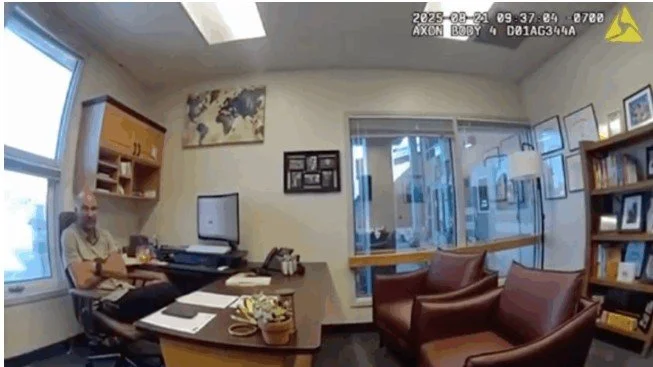
Screen shot of body cam footage from an interview as part of an investigation into what parents say were medical documents for their child forged by a school nurse. School police determined the nurse did nothing wrong when she signed a form with her name on the Parent/Guardian signature line.
“Too often, these obligations are minimized — whether by overlooking the seriousness of noncompliance or treating accommodations as optional,” Carpenter said. Families, she added, “do feel forced to escalate to [U.S. Department of Education’s Office for Civil Rights] complaints or legal remedies just to have their child’s basic needs met.”
A ‘clerical error’
When the family raised concerns with school leaders, administrators allegedly dismissed the matter as a “clerical error.” Staff reported that the initial forms tied to Ava’s medical accommodations from her previous school were “lost,” leaving no evidence to show whether the nurse altered them.
“Families often face communication barriers or get labeled as ‘difficult’ for advocating for their child.”
The family friend said the district’s response was dismissive. “The district’s response was just ‘clerical error.’ That’s extremely concerning,” they said. “Regardless of anything else, it’s a HIPAA violation — you cannot contact her doctor without consent.”
Carpenter said there is “limited training for staff, constrained resources and at times a culture that doesn’t prioritize compliance unless families actively advocate” at the school district. She added that enforcement of IEPs tends to be stronger because families must legally be included in changes, while “504 plans don’t legally require family involvement for revisions, which can result in less accountability and follow-through.”
Lack of consequences questioned
According to the police report from Aug. 21, a school police officer noted, “After investigation, I determined the nurse signed her own signature on the wrong line. I discovered the form that was sent to the doctor’s office was an old ‘consent and request for medication assistance during school hours’ form… [The nurse] states that she did not realize it was the old form and just signed the bottom line thinking it was where she was supposed to sign.”
Officer Jeremy Backman with WCSD Police did not list the nurse as a suspect in his report and concluded the investigation before talking with the nurse, Ava’s doctor, Ava’s father and Ava herself.
Schools must have a valid, current medication form on file for each student. WCSD policy requires a “Consent & Request for Medication Assistance During School Hours” form, such as HEA-F205, with a healthcare provider signature, parent signature and the correct school name.
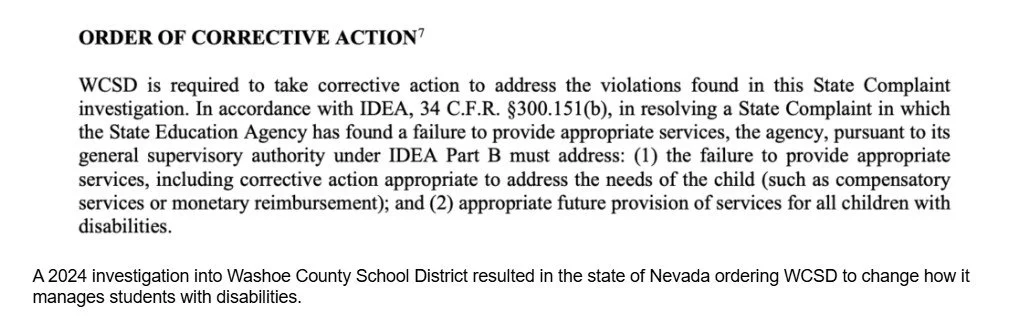
A 2024 investigation into Washoe County School District resulted in the state of Nevada ordering WCSD to change how it manages students with disabilities.
In the police report, however, the school’s name is not Spanish Springs Elementary, but Bohach Elementary. According to state law, using a consent form that names the wrong school, or one with a date that’s expired or invalid, violates rules under both district policy and state nursing statutes.
Moreover, state nursing regulations mandate that a school nurse may not administer — or delegate administering — medication unless they have “written authorization from the parent or legal guardian,” and the medication is properly labeled and dispensed by a licensed professional.
Body cam footage from the police officer reveals a time-stamped interview with the nurse conducted after the official police report had already been filed and closed. The recording of this interview begins while in the middle of a conversation with the principal in the principal’s office.
“We emphasize that our schools have and continue to operate safely and in compliance with legal and educational standards, and the safety and well-being of our students remain our highest priority.”
Before the interview with the nurse begins, the footage records the officer noting that the report was filed and that no criminal charges would be brought against the nurse. The roughly four-minute interview captures the nurse, school principal and officer discussing how the event is an accident.
They also appear to strategize ways to protect the nurse and her reputation, even implying that school police would be called should Ava’s mother approach the nurse.
“I don’t see anything criminal,” the officer tells the principal and nurse. “Through my investigation, there’s an old form and a new form. You signed the old form. Is that correct?” the officer asks the nurse.
The nurse said it has been many years since she had seen the old form after admitting to signing the old form. The officer then suggested the nurse follow a “safety plan” and to not talk with Ava’s mother, implying family members were a threat.
Investigations that go nowhere
The allegations have prompted complaints to other agencies, but according to the family and supporting witnesses, investigations have either been minimized or left incomplete.
The WCSD police report omitted details about the missing original forms. The released report ruled there were “no violations,” and attributed the nurse’s actions as having “no criminal intent.”
The Peace Officer Standards and Training Commission (POST) is reviewing the case, pursuing an investigation with allegations of misconduct. The proposal for an investigation raises questions about whether law enforcement handled the school police investigation appropriately.
The family reported the incident with the Nevada State Board of Nursing, which is now investigating the allegation.
Spanish Springs Elementary recorded in official documents that Ava’s parents had “declined” a 504 meeting, a claim the family disputes. Compounding their concerns, the family asserts that the school has continued uploading inaccurate entries into Ava’s health file, further adding to what the family said is questionable and misleading documentation.
Ava remains without consistent access to education in a setting that feels safe, according to those close to the family.
WCSD, through Public Information Officer Victoria Campbell, said they were aware of the family’s concerns but couldn’t comment on specific allegations.
“The issue has been thoroughly and appropriately investigated in accordance with WCSD policies and applicable laws and there were no findings of misconduct,” Campbell said. “Due to federal and state student privacy regulations, we are unable to share specific details. However, we emphasize that our schools have and continue to operate safely and in compliance with legal and educational standards, and the safety and well-being of our students remain our highest priority. We have and continue to be committed to maintaining an inclusive and compliant learning environment for all.”
A pattern at the school district
The problems at Spanish Springs Elementary mirror what some say is a wider issue in WCSD, where families across the district struggle to get schools to honor IEPs and 504 plans, even though thousands of students depend on them. In a 2021 report from the Nevada Department of Education, 10,420 students in Washoe County were counted as having an IEP or 504 plan (age 3-21) out of the district’s total number of students—that’s about one out of six students.
Kasey Mattice, whose daughter has diagnoses including ADHD, anxiety and PTSD, described years of frustration in dealing with the school district. Despite formal requests and medical documentation, Mattice said her daughter’s evaluations were delayed, dismissed as “backlogged” or downgraded to a 504 plan rather than the IEP she sought.
“For older children especially, I see a general unwillingness by the district to provide services or hold staff accountable,” Mattice said. “Children who should have IEPs are left to muddle by with 504s, and 504s are not legally enforceable in the same way.”
Mattice said she believes the problem stems partly from staffing shortages in special education, but also from administrative practices that prioritize less binding 504 plans and over more stringent IEPs. To parents like Mattice, these failures suggest systemic issues, not isolated mistakes.
Carpenter said this is a common theme. “Families often face communication barriers or get labeled as ‘difficult’ for advocating for their child,” she said. “Some even feel intimidated or discouraged from pressing the issue, which creates a real barrier to equity.”
Parents say WCSD has a pattern of sidelining students with IEPs or 504 plans, often downplaying their needs while focusing instead on shielding the district from allegations.
In 2014, KUNR reported the state of Nevada formally reprimanded WCSD for missing a deadline to train staff and revise special education policies. The investigation revealed that the district had denied services under some students’ IEPs, leading the state to mandate corrective action and additional oversight of WCSD’s compliance practices. This reprimand revealed systemic gaps in the district’s handling of federally required accommodations.
In 2022, Sparks mother Shannon Lindemann spoke publicly with a KRNV reporter about her ongoing struggle with WCSD to secure the services her adopted son needed for ADHD, anxiety and bipolar disorder. Despite medical documentation and repeated requests, Lindemann said the district consistently failed to provide adequate individualized support.
“Honoring 504 accommodations is not only a legal requirement but also a moral one.”
More recently, in 2024, WCSD itself conceded noncompliance in a state-filed complaint. The district acknowledged it failed to fully implement a student’s IEP at the start of the 2024–2025 school year, refusing to enact a May 2024 plan without parental agreement. That refusal delayed critical services, and WCSD admitted it had violated the Individuals with Disabilities Education Act (IDEA) and state rules in the process.
WCSD isn’t alone in denying students needed support. In 2024, District Court Judge David Hardy ruled that the Nevada Department of Education (NDE) refused to fund residential placement for a student with disabilities, violating state laws and denying the student’s constitutional rights. Records show NDE not only denied the request, but also tried to repeal the law that required the student’s placement in a residential program.
Rather than implementing the judge’s ruling, NDE launched an investigation into WCSD for speaking out at all. The case dissolved once the court forced NDE to halt the investigation and fund the student’s residential placement.
For families in Washoe County, there are broader concerns about whether students with disabilities are receiving the protections they are legally entitled to.
Ava’s family called the situation appalling: “I have a child in this district, and I’m appalled,” they said. “This family has been silenced. We should be telling every media outlet in the area what’s going on. It’s crazy that WCSD is putting parents in this situation.”
Call to action
Carpenter said that solutions exist: stronger staff training, proactive monitoring and treating 504s with the same seriousness as IEPs. “Parents should document everything, remain persistent but collaborative and know that they have both rights and options,” she said.
Her final message to WCSD leadership is to honor requirements. “Honoring 504 accommodations is not only a legal requirement but also a moral one,” she said. “When we fail to provide students with the support they need, we’re limiting their potential. Every student deserves the chance to succeed.”
The family at the center of this case hopes their experience will not stand alone, but instead spark a broader movement that can be recognized by the Department of Justice.
Ava’s family members would not comment for this story, and her family has retained legal counsel, allegedly planning to take the case to court. The student’s name appears as a pseudonym to protect her privacy.
Disclosure: The reporter previously worked for the Washoe County School District.
